
What is fascia? The body’s hidden connective network, eplained.
Have you ever cut into a raw chicken breast?
Just under the skin, there's a thin, shiny, silvery sheet that clings to the meat. It's slippery, a little stretchy, and surprisingly hard to tear.
That sheet is fascia. All mammals have it, and so do you. It's in your neck, your feet, your back, and everywhere in between.
For a long time, anatomy classes treated fascia as packing material, the stuff cleared away to get a better look at the "important" parts. That view is changing.
Researchers now study fascia as a living tissue that helps you move, sense your body, and feel pain. Here's what we know, and what we're still figuring out.
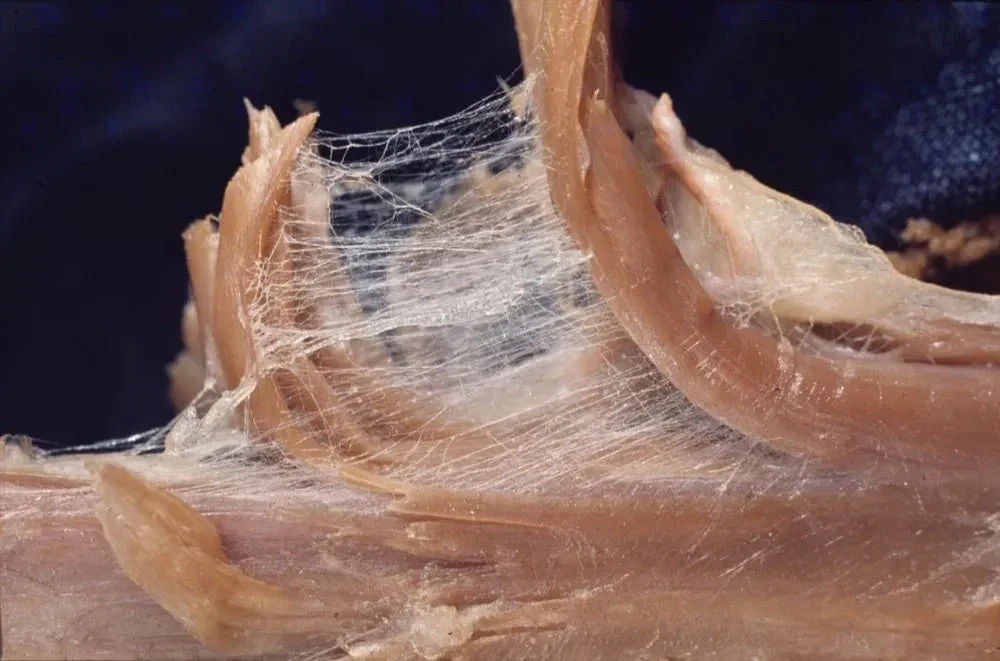
But what is it, scientifically?
Fascia is a type of connective tissue.
That's the soft, tough material that holds your body together. It wraps around muscles, bones, nerves, blood vessels, and organs. It also runs between them, so everything stays in place but can still move.
It comes in many forms. In some places it's a thin, almost see-through film. In others it's thick and strong, like the infamous IT band which runs along the side of your thighs. Tendons and ligaments are also close relatives to fascia.
One honest note: scientists still disagree about exactly where fascia ends and other connective tissue begins. The word covers a lot of ground. That's normal for a field that's still growing.
Fascia doesn't stop at the edge of a muscle. It's one continuous web, and it comes in layers:
A loose layer sits right under your skin and lets the skin slide over what's below.
A tougher layer wraps your muscles in sheets, almost like a sleeve.
Thinner wraps surround each muscle, and even the tiny bundles of fibers inside it.
Picture a knit sweater. Snag a thread at the cuff, and the fabric puckers near your elbow. Fascia can work a little like that. Studies show muscles don't only pull on bones through their tendons. They also pass some of their force to neighboring tissue through fascia.
Researchers have also found fascial links that run between regions, such as from the low back into the hip and thigh. How much those links matter in everyday movement is still being studied. But it helps explain why a problem in one spot can sometimes show up somewhere else.
One interconnected web
Fascia can feel
Here's the part that surprised many scientists: fascia is packed with nerve endings.
Some detect pressure and stretch. Some help your brain know where your body is in space, a sense called proprioception. And some detect pain.
In lab studies, irritating the fascia in the low back caused more lasting pain than irritating the muscle underneath it. That suggests fascia can be a real source of pain, not just a bystander.
So fascia isn't only packaging. It's part of how your body talks to your brain. When you notice a tight shoulder or a stiff back, fascia may be part of the message.

Fascia adapts to how you use it. Move in lots of ways, and it tends to stay responsive and springy. Stay still for long stretches, or repeat the same motion thousands of times, and it can get thicker and stiffer. Injury and surgery can leave scar tissue that makes layers stick together instead of sliding.
Ultrasound studies of people with long-lasting low back pain found something interesting. In many of them, the fascial layers in the back slid less easily and the tissue looked thicker.
As a Rolfer, I spend my days working with this tissue and the people living in it. Fascia isn’t a “trend” in the health and wellness industry. But it’s also not completely understood.
With that said, just because “we don’t know yet” doesn’t mean it’s something we shouldn’t pay attention to right now.
When fascia gets stiff